Радон-222 — инертный α-радиоактивный газ; сам по себе он не создаёт значимого поля внешнего γ-излучения. Его короткоживущие дочерние продукты (²¹⁴Pb T½=26.8 мин, ²¹⁴Bi T½=19.9 мин) — γ-излучатели. В подвале (прямой контакт с грунтом, слабый воздухообмен) ОА радона высока и легко управляема вентиляцией. Вопрос: детектируется ли рост ОА радона энергокомпенсированным γ-дозиметром как приращение МЭД/cps и какова величина коэффициента связи (нЗв/ч и имп/с на 100 Бк/м³)?
Гипотеза H₁: при кратном росте ОА радона МЭД и cps получат малое систематическое положительное приращение за счёт γ-фона дочерних. H₀: приращение неотличимо от нуля в пределах разрешения прибора и статистического шума.
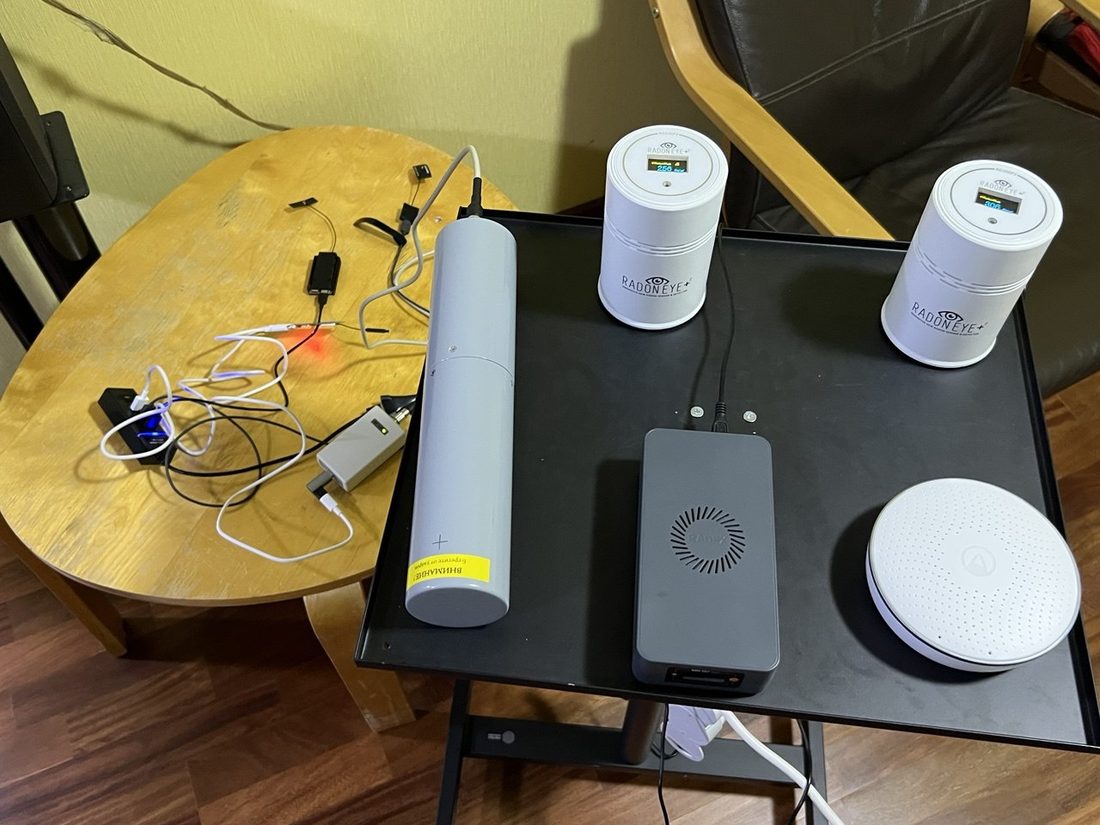
Слева — БДКГ-05 (цилиндр) и шлюз RADW (тёмный блок в центре); справа — два RadonEye Plus2; белая шайба — AtomFast (в расчёте не участвует). Клик по фото — увеличить.
Подвал жилого дома, приборы рядом (~0.3 м), T≈24 °C, влажность 52–55%. Управляемая переменная — приточно-вытяжная вентиляция.
11.07 до 19:30 — вентиляция включена, ОА радона 250–400 Бк/м³ (состояние A). В 19:30 11.07 вентиляцию выключили → накопление радона от эманации грунта; ОА монотонно растёт ~16 ч до плато 1150–1300 Бк/м³ (состояние B, 12.07).
| Прибор | Величина | Ед. |
|---|---|---|
| БДКГ-05 детектор МЭД | МЭД H*(10) | мкЗв/ч |
| БДКГ-05 счётный канал | cps (сред. 2 мин) | имп/с |
| Шлюз RADW (ESP32, atomtex-esp32) → Home Assistant | телеметрия | — |
| RadonEye Plus2 | ОА радона | Бк/м³ |
| Параметр | Атомтех БДКГ-05 | Ecosense RadonEye Plus2 |
|---|---|---|
| Тип детектора | NaI(Tl) Ø40×40 мм (сцинтилляционный, энергокомпенс.) | импульсная ионизационная камера |
| Измеряемая величина | МЭД H*(10), скорость счёта | ОА радона-222 |
| Диапазон | МЭД 0.03–300 мкЗв/ч; доза 0.03 мкЗв–0.3 Зв | до ~9400 Бк/м³ |
| Энергодиапазон γ | 50 кэВ – 3 МэВ | — |
| Чувствительность | 760 имп·с⁻¹ / (мЗв·ч⁻¹) по ¹³⁷Cs | — |
| Основная погрешность | ±20 % (МЭД) | ±10 % (паспорт) |
| Условия | −30…+50 °C, влажн. до 95%, IP64 | комнатные |
Источники: БДКГ-05 — ekosf.ru/product/bdkg-05; RadonEye Plus2 — паспорт Ecosense.
timestamp_msk (МСК); ресэмплинг 5 мин.погрешность_ЦПС/погрешность_МЭД (%), для радона — паспортные ±10 %.Уровень окна 1 ≈84.7 → окна 2 ≈94.0 имп/с. Пуассоновский разброс ~±1.6%.
Квант индикации ~0.001 мкЗв/ч. Плато сост. A ≈0.0714 → сост. B ≈0.0809 мкЗв/ч.
Левая ось — радон, правая — cps. Окно 1 захватывает старт подъёма (после выключения вентиляции), окно 2 — плато.
| Величина | Сост. A (вент. вкл) | Сост. B (плато) | Δ | Δ отн. | на 100 Бк/м³ (ДИ₉₅) |
|---|---|---|---|---|---|
| ОА радона, Бк/м³ | 318±49 | 1193±71 | +875 | ×3.75 | — |
| cps, имп/с | 84.69 | 93.96 | +9.27 | +11.2% | +1.06 [1.04–1.08] |
| МЭД, мкЗв/ч | 0.0714 | 0.0809 | +9.5 нЗв/ч | +13.5% | +1.09 [1.03–1.16] нЗв/ч |
Оба независимых канала БДКГ дают согласованный удельный коэффициент ≈1.06–1.09 на 100 Бк/м³ — сильный аргумент, что приращение реально, а не артефакт одного канала. 95% доверительные интервалы не включают нуль — приращение статистически значимо (уровень α=0.05).
| Окно | Диапазон радона | N (5-мин) | N_эфф | r (Пирсон) | p (N_эфф) | наклон cps/100 | Значимость |
|---|---|---|---|---|---|---|---|
| окно 1 (вечер 11.07) | 222–433 | 273 | 217 | 0.168 | 0.013 | 0.94±0.34 | слабо значима |
| окно 2 (день 12.07) | 987–1297 | 113 | 99 | 0.139 | 0.172 | 0.69±0.47 | не значима |
Окно 1 захватывает начало подъёма (радон 222–433 Бк/м³) → слабая положительная связь на грани значимости. Окно 2 — плато (узкий диапазон) → сигнал тонет в пуассоновском разбросе cps. Контраст между состояниями (Δ=875 Бк/м³) на порядок мощнее.
Сам ²²²Rn — α-излучатель (Eα=5.49 МэВ), для внешнего γ-поля вклад пренебрежим. Приращение МЭД даёт γ-линейка равновесных дочерних: ²¹⁴Pb (295, 352 кэВ) и ²¹⁴Bi (609, 1120, 1764 кэВ). При коэффициенте равновесия F≈0.4–0.5 рост ЭРОА на ~350 Бк/м³ создаёт добавку МЭД порядка единиц–десятков нЗв/ч — согласуется с измеренным +10 нЗв/ч. Порядок величины подтверждает механизм.
МЭД БДКГ квантуется ~0.001 мкЗв/ч при основной погрешности ±20%; изменение +0.010 мкЗв/ч — на уровне ~1 кванта и глубоко внутри паспортной погрешности. Обнаружить его удалось только усреднением десятков точек в двух стабильных плато (снижение случайной составляющей ∝1/√n). Методический вывод: слабый радон-индуцированный γ-сигнал извлекается статистически, но не по мгновенному показанию.
experiments\2026-07-11_БДКГ05_RadonEye\ · данные HA (МСК): bdkg_export_2026-07-11_0000_to_now.csv, radoneye_export_2026-07-11_2026-07-12.csv · контур «Радоновый риск» · 2026-07-12.Radon-222 is an inert α-radioactive gas; on its own it produces no appreciable external γ field. Its short-lived progeny (²¹⁴Pb T½=26.8 min, ²¹⁴Bi T½=19.9 min) are γ emitters. In a basement (direct contact with the soil, weak air exchange) radon activity is high and easily controlled by ventilation. The question: is a rise in radon activity detectable by an energy-compensated γ dosimeter as an increment of ADER/cps, and how large is the coupling coefficient (nSv/h and cps per 100 Bq/m³)?
Hypothesis H₁: a several-fold rise of radon activity yields a small systematic positive increment of ADER and cps due to the γ background of the progeny. H₀: the increment is indistinguishable from zero within the instrument resolution and statistical noise.
Left — BDKG-05 (cylinder) and the RADW gateway (dark box in the centre); right — two RadonEye Plus2; the white puck is an AtomFast (not used in the analysis). Click the photo to enlarge.
Basement of a residential building, instruments side by side (~0.3 m), T≈24 °C, humidity 52–55%. The controlled variable is the supply-and-exhaust ventilation.
On 11.07 until 19:30 the ventilation was on, radon activity 250–400 Bq/m³ (state A). At 19:30 on 11.07 the ventilation was switched off → radon accumulation from soil emanation; the activity rises monotonically for ~16 h to a plateau of 1150–1300 Bq/m³ (state B, 12.07).
| Instrument | Quantity | Unit |
|---|---|---|
| BDKG-05 ADER detector | ADER H*(10) | µSv/h |
| BDKG-05 counting channel | cps (2-min avg) | cps |
| RADW gateway (ESP32, atomtex-esp32) → Home Assistant | telemetry | — |
| RadonEye Plus2 | radon activity | Bq/m³ |
| Parameter | Atomtech BDKG-05 | Ecosense RadonEye Plus2 |
|---|---|---|
| Detector type | NaI(Tl) Ø40×40 mm (scintillation, energy-compensated) | pulsed ionization chamber |
| Measured quantity | ADER H*(10), count rate | radon-222 activity |
| Range | ADER 0.03–300 µSv/h; dose 0.03 µSv–0.3 Sv | up to ~9400 Bq/m³ |
| γ energy range | 50 keV – 3 MeV | — |
| Sensitivity | 760 s⁻¹ / (mSv·h⁻¹) for ¹³⁷Cs | — |
| Basic uncertainty | ±20 % (ADER) | ±10 % (data sheet) |
| Conditions | −30…+50 °C, humidity up to 95%, IP64 | indoor |
Sources: BDKG-05 — ekosf.ru/product/bdkg-05; RadonEye Plus2 — Ecosense data sheet.
timestamp_msk (MSK); resampled to 5 min.cps_uncertainty/ADER_uncertainty (%), for radon — the data-sheet ±10 %.Level of window 1 ≈84.7 → window 2 ≈94.0 cps. Poisson spread ~±1.6%.
Indication quantum ~0.001 µSv/h. Plateau state A ≈0.0714 → state B ≈0.0809 µSv/h.
Left axis — radon, right — cps. Window 1 captures the start of the rise (after the ventilation shut-off), window 2 — the plateau.
| Quantity | State A (vent. on) | State B (plateau) | Δ | Δ rel. | per 100 Bq/m³ (95% CI) |
|---|---|---|---|---|---|
| radon, Bq/m³ | 318±49 | 1193±71 | +875 | ×3.75 | — |
| cps | 84.69 | 93.96 | +9.27 | +11.2% | +1.06 [1.04–1.08] |
| ADER, µSv/h | 0.0714 | 0.0809 | +9.5 nSv/h | +13.5% | +1.09 [1.03–1.16] nSv/h |
Both independent BDKG channels give a consistent specific coefficient ≈1.06–1.09 per 100 Bq/m³ — strong evidence that the increment is real and not an artefact of a single channel. The 95% confidence intervals do not include zero — the increment is statistically significant (α=0.05).
| Window | Radon range | N (5-min) | N_eff | r (Pearson) | p (N_eff) | slope cps/100 | Significance |
|---|---|---|---|---|---|---|---|
| window 1 (evening 11.07) | 222–433 | 273 | 217 | 0.168 | 0.013 | 0.94±0.34 | weakly significant |
| window 2 (day 12.07) | 987–1297 | 113 | 99 | 0.139 | 0.172 | 0.69±0.47 | not significant |
Window 1 captures the start of the rise (radon 222–433 Bq/m³) → a weak positive relation, borderline significant. Window 2 is the plateau (narrow range) → the signal drowns in the Poisson spread of cps. The between-state contrast (Δ=875 Bq/m³) is an order of magnitude stronger.
²²²Rn itself is an α emitter (Eα=5.49 MeV), negligible for the external γ field. The ADER increment comes from the γ lines of the equilibrium progeny: ²¹⁴Pb (295, 352 keV) and ²¹⁴Bi (609, 1120, 1764 keV). With an equilibrium factor F≈0.4–0.5, a rise of the EEC by ~350 Bq/m³ produces an ADER addition of the order of units–tens of nSv/h — consistent with the measured +10 nSv/h. The order of magnitude confirms the mechanism.
The BDKG ADER is quantized at ~0.001 µSv/h with a basic uncertainty of ±20%; a change of +0.010 µSv/h is at the level of ~1 quantum and deep within the data-sheet uncertainty. It could be detected only by averaging tens of points across the two stable plateaus (the random component drops as ∝1/√n). Methodological conclusion: a weak radon-induced γ signal is extracted statistically, but not from an instantaneous reading.
experiments\2026-07-11_БДКГ05_RadonEye\ · HA data (MSK): bdkg_export_2026-07-11_0000_to_now.csv, radoneye_export_2026-07-11_2026-07-12.csv · «Radon risk» workstream · 2026-07-12.